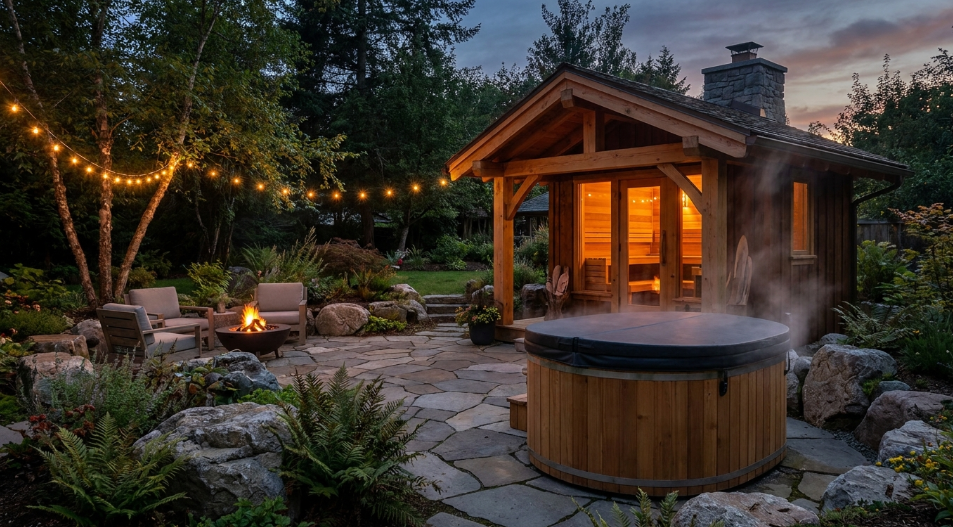
A daily-use outdoor sauna for two works best with a two to three-person cabin placed close enough to the house that weather never becomes an excuse, a hard-surfaced entry that stays dry underfoot, exterior lighting for evening sessions, and a heater built for frequent cycling rather than occasional weekend use. The sauna itself matters less than the small details around it that determine whether the habit actually survives past the first rainy week. Here is how to build that setup piece by piece.
Start With Distance From the House, Not Yard Size
It is tempting to tuck a sauna at the back of a large lot for privacy, but distance is the single biggest predictor of whether a couple actually uses a cabin daily. A sauna 20 or 30 steps from the back door gets used far more consistently than one across a big yard, especially once the novelty wears off and a two-minute walk in the cold or rain becomes the exact kind of small friction that quietly ends a daily habit within a month. If privacy matters, solve it with a simple screen or fence panel near the cabin rather than by pushing the whole structure further away.
Choose a Hard Surface Entry, Not Bare Grass or Dirt
Two people walking to and from a sauna every day wears a path into grass within a few weeks, and that path turns to mud the first time it rains. A small gravel apron, a run of pavers, or a compact deck section at the entrance solves this permanently and costs relatively little compared to the sauna itself. Grade the ground so water drains away from the doorway rather than pooling at the threshold, since standing water at the entry is both a slip hazard and a fast way to rot a wooden sill over a few seasons.
Add a Covered Walkway if Your Climate Sees Regular Rain or Snow
This is the detail that separates a sauna that gets used year-round from one that quietly stops getting used every October. A short roofed walkway or even a simple awning over the last stretch to the door means neither person has to decide between skipping a session or getting soaked walking back barefoot. It does not need to cover the whole distance from the house, just enough to remove the worst of the exposure right at the cabin entrance.
Plan Exterior Lighting for After-Dark Sessions
Daily use for a working couple often means evening sessions after dark for much of the year. Path lighting along the walkway and a fixture at the cabin door are the minimum for safe daily use, and motion-activated fixtures remove the need to fumble for a switch with wet hands or a towel over one shoulder. This is a small electrical add-on worth planning at the same time as the sauna’s own power run, rather than as an afterthought wired in later.
Size the Cabin and Heater for Two, Not for Guests
A two to three-person footprint, roughly 4 by 5 feet to 5 by 6 feet of interior space, heats fast and keeps running costs low enough that daily use never feels like a splurge. A heater rated for frequent cycling matters more here than for an occasional-use cabin, since daily heating and cooling puts real hours on the element. For an outdoor two-person setup, that typically means an infrared unit in the 1.5 to 2 kW range or a compact traditional electric heater around 4.5 to 6 kW, both sized appropriately without being underpowered against outdoor heat loss.
Screen the Site for Privacy Without Losing Proximity
A daily-use cabin close to the house sometimes sits closer to a neighbor’s yard or a shared fence line than an owner would ideally like. A simple privacy screen, a section of lattice, a row of tall planters, or a short fence panel near the cabin solves this without sacrificing the short walk that keeps the habit realistic. Trying to solve privacy by distance instead almost always costs more in reduced daily use than a $200 to $400 screening solution would have.
Choose Weatherproof Materials Since This Is a Daily-Contact Structure
A sauna used once a week can get away with materials that are merely adequate outdoors. One used every day for years needs benches, door hardware, and a threshold that hold up to constant exposure without warping, sticking, or degrading faster than expected. Bench wood rated for exterior use, properly sealed and re-oiled on schedule, resists the moisture cycling that comes from being heated daily and then cooling back down to outside temperature every single evening. Door hardware matters here too. A basic indoor-grade hinge or latch corrodes faster outdoors than a stainless or weather-rated equivalent, and for a door opened and closed multiple times a day, that difference shows up within a year or two rather than a decade.
The threshold and door seal deserve particular attention for a daily-use cabin specifically because they get more wear than an occasional-use unit ever sees. A worn seal lets in cold air and moisture with every open-close cycle, which compounds fast at twice-daily use compared to a weekend cabin opened a handful of times a month. Checking the door seal every season and replacing it before it visibly fails keeps heat loss and moisture intrusion from creeping up gradually in a way that is easy to not notice until the heater is working noticeably harder than it used to.
Compare Two-Person Models on Real Specs
Heater wattage, interior floor dimensions, and how a manufacturer rates the cabin for outdoor exposure are the numbers that matter for a daily two-person setup, not the lifestyle photography most listings lead with. SweatDecks saunas lists these specs directly on individual product pages, which makes it easier to compare a compact infrared cabin against a slightly larger traditional model on the numbers that actually determine whether it holds up under daily outdoor use.
Frequently Asked Questions
How close to the house should a daily-use outdoor sauna sit?
As close as your yard allows without sacrificing clearance requirements. A short walk under a minute keeps daily use realistic.
Does a covered walkway matter for daily sauna use?
It helps more than most buyers expect. A roofed path or short awning removes the friction of stepping through rain or snow barefoot.
What exterior lighting do you need for evening sessions?
Path lighting and a fixture near the door are the minimum. Motion-activated lights turn on automatically without anyone fumbling for a switch.
How do you keep the area around an outdoor sauna from turning muddy?
Grade the site so water drains away from the entrance, and add gravel, pavers, or a small deck. Bare soil wears into mud fast under daily foot traffic.
References
- “Cardiovascular and Other Health Benefits of Sauna Bathing: A Review of the Evidence.” Mayo Clinic Proceedings, 2018. https://pubmed.ncbi.nlm.nih.gov/30077204/
- “Benefits and risks of sauna bathing.” The American Journal of Medicine, 2001. https://pubmed.ncbi.nlm.nih.gov/11165553/
- “Does the Combination of Finnish Sauna Bathing and Other Lifestyle Factors Confer Additional Health Benefits? A Review of the Evidence.” Mayo Clinic Proceedings, 2023. https://pubmed.ncbi.nlm.nih.gov/37270272/